A Name That Winks: Building a Pin-Up Persona That Still Sounds Like You
Say "Rita Rue" out loud. It lands like a door closing on a punchline. Now say "Dolly Delight." Different sound entirely — rounder, sillier, a name that arrives wearing a bow. Two words apiece, and you already know what the photo set looks like. That's not an accident.
Stage names have been doing this work for a century, from burlesque marquees to roller derby rosters to drag houses, and the mechanics haven't changed. A name is the shortest possible pitch. It tells an audience what kind of evening they're in for before they've clicked anything.
What has changed is the audience's tolerance for the mask.
The Case for a Little Theater
There's a strain of advice going around that says stage names are dated — that in an era of real names and personal brands, anything invented reads as fake. I don't buy it. What reads as fake isn't invention, it's invention with nothing behind it.
A persona is a frame, and frames are useful. A name gives you permission to be a bigger, more stylized version of yourself for an hour: different posture, different walk, a little more drawl in the captions. It also gives you a boundary. The name takes the spotlight; the person behind it stays a person.
That boundary is worth more now than it's ever been, honestly. When every platform nudges performers toward oversharing, having a marquee name to hide behind — and to step out from when you choose — is a form of professional self-respect.
What a Name Does to a Photo Set
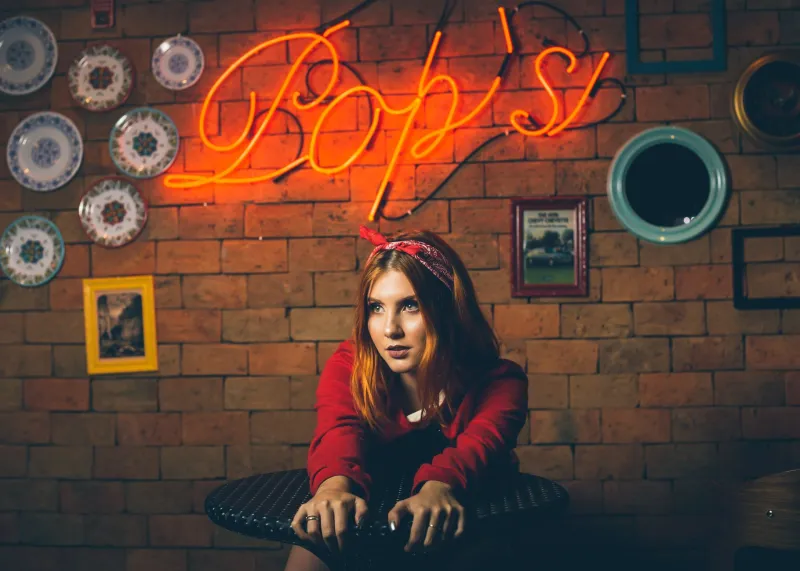
Watch what happens when a photographer hears the name before the shoot. "Rita Rue" pulls the room toward a jukebox, a diner booth, a cherry-red lip and a slightly crooked eyebrow. "Dolly Delight" pulls toward pastel balloons, gingham, a bubblegum wink, a set built out of a birthday party. Same model, same lighting budget, two completely different galleries.
That's the practical argument for choosing carefully. Your name is going to quietly steer wardrobe, set dressing, caption voice, and even which poses feel "on brand" for years. Choose one that points somewhere you actually want to go.
Vintage Is Not the Same as Gimmicky
The failure mode is real, and it usually looks like a name that's working harder than the performer. A few markers:
- Alliteration stacked three deep. Two matching sounds is memorable. Three is a nursery rhyme.
- A costume instead of a character. If the name only works in a sailor outfit, it's not a persona, it's a prop.
- A joke at the model's expense. If the name invites the audience to laugh at you rather than with you, it's the wrong name.
- A collision. Check it against living performers, famous cartoons, and trademarked characters before you print it on anything. Nobody needs that headache three months in.
- A spelling nobody can reproduce. Cute for a week, exhausting for a decade.
Three Questions Before You Commit
Run any candidate through this gauntlet.
One: does it survive a plain sentence? "Here's Rita Rue" should sound natural spoken by a stranger. If you have to explain how to say it, keep looking.
Two: can it flex? Imagine the name on a swimwear set, a holiday set, a black-and-white film set, and a modern streetwear set. If it only fits one, it's a costume name.
Three: does it leave room for you? A good persona has an open door in it. The audience should be able to sense that there's a real person doing the winking.
The Name Lab: Prompts Worth Stealing
If you're starting from nothing, don't start from a thesaurus of "vintage" words. Start from your own life and stylize it.
- A grandmother's first or middle name, kept exactly as it was spelled.
- The street you grew up on, or the town nobody's heard of.
- A flower, a cocktail, a car model, a brand of lipstick.
- Your actual first name with one letter changed, or a nickname only your family uses.
- A surname stolen from a favorite old film, a diner sign, or a highway exit.
Then apply the sound rules. Two syllables total usually beats four. A soft first name plus a hard-stopped last name — think Bettie Page, Tempest Storm, Lili St. Cyr — has punch and stays easy to say after two drinks. Honorifics and French particles ("Miss," "La," "Von") can work, but they commit you to a register, so commit on purpose.
Where Persona Ends and You Begin
This is the balance that defines the current era. Audiences in 2026 want the theatrical name and the real person behind it — the vintage frame and the modern voice inside it. Ten years ago a performer could live entirely inside the persona and nobody asked questions. Now the captions do some of that work, and the comments do the rest.
One performer we spoke with, who works under a two-word vintage moniker, put it this way: the name is for the marquee, and everything else is for the people who stick around. She keeps her legal first name in her captions, talks openly about her actual day job, and still signs every gallery with the stage name. Nothing about that is contradictory. It's just a well-built frame.
What doesn't work is the reverse — a persona with no person in it, all wink and no warmth. Audiences clock that fast, and they don't come back.
Say It Fifty Times
Before you commit to anything, write your top three candidates on a sticky note and leave them somewhere you'll see them for a week. Say each one out loud fifty times — in a sentence, on a voicemail, as if a photographer were introducing you. One of them will start to feel like a costume you're wearing. One will start to feel like a jacket that fits.
Pick the jacket. The wink can come later.