The Quiet Detail: Hand Language That Makes a Pin-Up Set Feel Alive
There is a moment in every pin-up shoot when the pose looks right, the light is behaving, and the curve line is doing exactly what it should — and then you notice the hands. Maybe they are flat and stiff. Maybe they are half-hidden behind a hip. Maybe they look like they are waiting for a bus. Hands are the quiet detail that decides whether a glamour frame feels effortless or accidentally tense, and for curve-forward pin-up work, they deserve their own plan.
At PB Gals, we talk a lot about shape, confidence, and the playful side of glamour. Hands belong in that conversation. They are not decoration. They are part of the story. A soft wrist can make a pose feel romantic. A strong, purposeful grip can make it feel playful. A hand resting lightly at the waist can draw the eye exactly where you want it. The goal is not perfect fingers. The goal is hands that look like they belong to a person who is having a good time.
Why Hands Read Loudly in a Curve-Forward Frame
In a full-body pin-up shot, hands are often the smallest element in the composition, but they are also one of the most expressive. They create angles. They create negative space. They point the viewer’s eye toward the waist, the hip, the face, or the prop. When they are stiff, the whole image tightens up. When they are relaxed, the pose breathes.
For models with real curves, hands can also help define shape without hiding it. A hand at the small of the back can emphasize the waist. A hand on the thigh can anchor a seated pose. A hand lifted near the collarbone can frame the face and neck. The trick is to make those placements feel natural, not staged. That starts with understanding what relaxed hands actually look like on camera.
The Claw Is Not a Personality Trait
The dreaded “claw” happens when a model tries too hard to make a hand look elegant. Fingers spread, joints lock, and the hand becomes a rigid starfish. It is especially common when someone is nervous or holding a pose longer than comfortable. The fix is not to force the hand into a prettier shape. The fix is to give the hand something to do.
Try this: let the fingers curve as if you are holding a small, invisible object — a plum, a perfume bottle, a playing card. Keep the thumb relaxed. Let the pinky soften. The hand does not need to be fully open to look expressive. In fact, a slightly curled hand often photographs better than a spread one because it feels more candid.
Another quick reset: shake out your hands between setups. Roll the wrists. Pretend you are flicking water off your fingertips. That small motion reminds the hand what relaxed feels like, and it shows up on camera.
Three Hand Placements That Flatter Real Curves
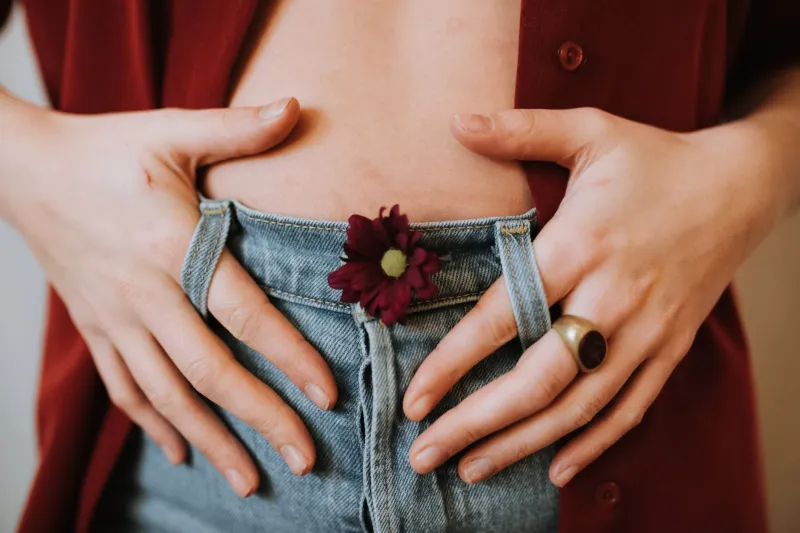
The waist anchor. Place one hand on the waist with the thumb forward and fingers relaxed toward the back. Do not squeeze. The hand should rest, not grip. This placement creates a natural triangle with the arm and draws attention to the waistline without looking posed.
The collarbone frame. Bring the fingertips lightly to the collarbone or the base of the neck. Keep the wrist soft. This is a classic pin-up gesture because it frames the face and adds a little old-Hollywood charm. The key is lightness. If the fingers press, the hand looks tense. If they hover, it looks intentional.
The thigh rest. For seated poses, let one hand rest on the thigh with the fingers slightly curved. This anchors the pose and gives the arm somewhere to go. Avoid flattening the palm. A soft, curved hand looks more elegant and keeps the line of the arm looking long.
Collaboration Beats Choreography
Photographers and models do their best hand work together. A photographer can see things the model cannot — a finger poking into the hip, a wrist that has gone stiff, a hand that is lost in shadow. But the model knows what feels natural. The best approach is a quick, low-pressure check-in between frames.
Try a simple call-and-response. The photographer says, “Give me something softer in the left hand,” and the model adjusts. Or the model says, “This hand feels weird,” and the photographer either fixes the light or suggests a micro-shift. No big directions. No lengthy explanations. Just small adjustments that keep the energy up.
It also helps to build hand language into the shoot plan. Before the first frame, decide on three or four hand moods: playful, soft, strong, flirty. Then let the model cycle through them like a playlist. That way the hands are not an afterthought. They are part of the performance.
Close-Up Gallery Ideas That Put Hands Front and Center
Hands do not have to stay in the background. A close-up gallery can be a smart addition to a pin-up set, especially for a 2026 audience that scrolls fast and looks for detail. Think about shots that crop in on the hands and forearms: a hand adjusting a stocking, fingers laced around a coffee cup, a palm pressed lightly against a velvet curtain, a wrist draped over the back of a chair.
These shots work because they are suggestive without being explicit. They add texture to the gallery and give the viewer a different kind of pause. They also give the model a break from full-body posing while still building the story. A hand close-up can be playful, moody, or glamorous depending on the light and the props. And yes, props are optional. A bare hand against a textured wall can be just as compelling as one holding a vintage telephone.
Drills You Can Try Before the Shoot
Stand in front of a mirror and run through five hand shapes: relaxed curl, soft point, gentle grip, open palm, and loose fist. Notice which ones feel natural and which ones make you tense up. Then try them again while talking or laughing. The goal is to keep the hands alive while the rest of you is in motion.
Another drill: set a timer for two minutes and hold a seated pin-up pose, changing only your hands every fifteen seconds. This teaches you how to adjust without breaking the pose. It also helps you find the hand shapes that read well from different angles.
Finally, practice handing off tension. If your hands feel stiff, relax your jaw and shoulders first. Tension travels. A loose shoulder often leads to a looser hand.
The Takeaway
Hands are not the headline of a pin-up photo, but they are the punctuation. They can make a curve look intentional, a pose look playful, and a gallery feel polished. The next time you plan a set — or step in front of the camera — give your hands a little direction. Not a rigid script. Just a mood, a softness, and a willingness to adjust. That is where the quiet detail becomes the memorable one.